EVALUATION OF CHOLINESTERASE INHIBITORY POTENTIAL OF N-FURAN-2-YLMETHYL- AND N-THIOPHENE-2-YLMETHYLBENZAMIDE AND SULFONAMIDE DERIVATIVES
Keywords:
benzamide, cholinesterases, sulfonamide, docking, synthesisAbstract
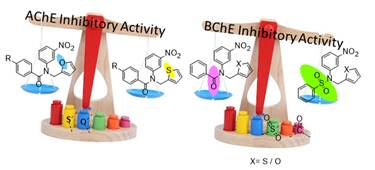
In this study a total of 16 new N-furan-2-ylmethyl- and N-thiophene-2-ylmethylbenzamide and sulfonamide derivatives were synthesized for the first time with 85–95% yield. The synthesized compounds' cholinesterase inhibitor potential (IC50 and Ki values) was assessed using spectrophotometric in vitro enzyme inhibition measurements. Benzamide derivatives containing thiophene ring showed greater activity than benzamide derivatives containing furan ring in AChE inhibition. In the inhibition of BChE, benzamide derivatives containing furan ring demonstrated greater activity than benzamide derivatives containing thiophene ring. Among the synthesized compounds, the compound with the highest potential to inhibit AChE was determined to be N-(3-nitrophenyl)-N-(thiophen-2-ylmethyl)benzamide (Ki 8.78 ± 1.87). The most effective inhibitor against BChE was N-(furan-2-ylmethyl)-4-methoxy-N-(3-nitrophenyl) benzamide (Ki 2.20 ± 0.36). N-(Thiophen-2-ylmethyl)sulfonamide derivatives inhibited AChE noncompetitively while N-(furan-2-ylmethyl)sulfonamide derivatives inhibited AChE competitively. In molecular docking studies, the binding free energy of N-(furan-2-ylmethyl)-4-methyl-N-(3-nitrophenyl)benzenesulfonamide (–10.84 kcal/mol) to AChE (PDB: 4EY7) was found to be higher than the binding free energy of other compounds to 4EY7 (–7.25 to –10.07 kcal/mol). On the other hand, the binding free energy of 4-bromo-N-(3-nitrophenyl)-N-(thiophen-2-ylmethyl)benzamide (–11.01 kcal/mol) to BChE (PDB: 4BDS) was found to be higher than the binding free energy of other compounds to 4BDS (–6.70 to –11.01 kcal/mol).